

Completing tasks gives us the juicy satisfaction of knowing we did what we were supposed to do.
But we often neglect to tap into the deeper opportunity the task gives us. We’re not thinking, we’re just doing.
Simply doing has a tap-out point. Not just in terms of compensation, but also satisfaction, empowerment, and engagement.
I can teach you how to steam milk in an hour and you’ll barely need to be paying attention. It’s that easy.
It’s important.
It’s fun.
It connects.
But at the end of the day who do we want to be surrounded by: a group of milk steamers, or a group of leaders who also happen to steam great milk?
So we have to make a different ask and a bigger investment.
We need to help people learn to see.
To be engaged on a level where they don’t just know what they’ve done, but what they’ve learned, and how they can pay it forward. To tap into lessons that reward their effort exponentially.
Steaming milk is a useless skill to have outside of the cafe world—but feeling empowered to engage in critical thinking to solve problems, connect dots, and lift up others are skills that are valuable everywhere.
“How do you find such amazing people?!”
We get asked this question all the time.
While our team does a great job in hiring people that resonate with our culture, the truth is that amazing people are everywhere.
If you’ve been having a hard time seeing what we see, here are a few questions to ask yourself:
Do you have a solid idea of who you are as an organization, and share it with your people?
Have you shown people the impact their work has on the organization, its guests, and beyond?
Have you done the work to unlock the gifts inside the people you already have?
Have you communicated clear expectations and followed up on them?
Are you creating a safe environment where people can fail forward?
Do you care about the person standing in front of you?
The list goes on but you get the idea.
Choosing the defeatist attitude of “I can’t find any good people” says more about you than it does about the people who work for you.
I realize that shaming someone isn’t the best way to promote change, so if this stings a little—I get it, I’ve been there. This isn't easy work but it’s the work that matters, and it’s the work you signed up for whether you knew it or not.
So what’s more empowering: Operating from the belief that there’s a fixed number of talented, caring people out there, or looking inward and seeing what you can do help the people around you realize their potential?
Just imagine how rewarding it would feel to be surrounded by a group of confident and creative people all working together towards a common goal. That’s what work can be, and you can be the catalyst.
As we move through our lives, different seasons and situations give us different opportunities.
I stumbled into my first coffee job by accident. It was just supposed to be a pit stop. That short-term gig spiraled into an obsession that’s taken me all over the world, introduced me to some of my closest friends, and given me a space to learn, grow, and contribute.
Almost two decades later my day-to-day work has very little to do with coffee.
Leaning In
Leaning into our work allows us to create impact, connect with people, and tap into opportunities that we didn’t even know existed.
I never wanted to be in the coffee industry until I was in the coffee industry. I never wanted to be a business owner until I was a business owner. I’m not sure what the next chapter will bring but one thing has become clear to me: People's gifts have nothing to do with any particular career or job title.
Action
The job you have isn’t as important as how you view that job (What impact am I making?) and how you show up to that job (Am I leaning into the work and giving my best effort?).
Waiting to contribute until you have the opportunity you want might hold you back from creating the opportunity you need.
Since many business owners seem to see employees as a necessary evil "I have to go deal with my employees..." I'd like to offer an alternative perspective:
Employees are your biggest force multipliers. Infinitely more people will interact with your business through your employees than through you. Your employees are deeply connected to your guests, and the perception of your organization has more to do with the interactions they have with your employees than it does with your latest social media post. (You can only fudge the truth for so long.)
To put it into perspective:
Out of all the cups of coffee we've served today, I've personally served zero.
Out of all the packages we've shipped, I've shipped zero.
I haven't made any calls to wholesale partners or vendors, and I haven't fielded any guest emails.
That's all done by our amazing team.
So if you're fed up with your employees, here are a few questions to mull over:
What role have you played in creating this culture of resentment?
Will you accept the responsibility to reshape that culture?
Where would your business be if you had no employees?
Employees are first and foremost humans. This post is aimed at those who may need a little push to see how the human and business aspects of work are actually in perfect alignment, regardless of what traditional business practices tell us.
I've had a few big wins.
While I'm proud of what I've been able to accomplish, wins often feel like they come with the burden of expectation.
Let's set aside the fact that those expectations are projections created in my head. Self-imposed or not, these expectations feel real.
When the expectation is perfection - you lose. You can't move forward in any meaningful way without hitting a few bumps in the road.
But if the expectation is to contribute, you have the freedom to experiment—to swing at more things and know that even if you miss, even if your batting average is terrible, you'll still get more hits this way than if you stay in the dugout.
Plainly put: the best way to get more hits is to get more at-bats.
Yes, you'll have more misses this way too, but unless you're a baseball player, no one's going to look at your batting average, they're going to look at your work.
What have you created? What have you contributed?
Here's to letting our successes inspire us, not stress us out.
Actions speak volumes, but when we're helping someone through a training phase, it's useful to remember that they may have not yet developed the skill to have their actions meet the level of their intentions.
A committed player needing a nudge in the right direction might look the same as someone who's actively avoiding responsibility.
I've found I have the most useful conversations when I dive in assuming the former.
Movies that move our soul all start with a strong vision that is then brought to life with great acting.
The actors can't play their part without understanding the vision, and it's the role of the director to communicate that vision.
Painting the picture of what's in our heads to the people around us can be a challenge. I've often struggled with the nagging question: "Why don't they just get it?!"
Part of this is the frustration of something feeling painfully obvious to me, yet somehow everyone around me seems oblivious. The other part is frustration with myself for not putting in the work it takes to effectively communicate my vision.
This is the gift of leadership: seeing possibilities that others don't, and being able to open doors that people didn't even know existed.
Painting the picture is more than listing facts, and pushes far beyond the transactional relationship many of us have with work ("Do this because I pay you to!"), it's about creating an emotional connection to another world.
Visions we're unable to communicate are just ideas, and ideas that live only inside our heads don't help anyone.
You might have the vision that someone's been waiting for, best not to keep it to yourself.
The more we show up with our best effort wherever we are, the better our chances of ending up where we want to be (even if we don't know where that is yet).
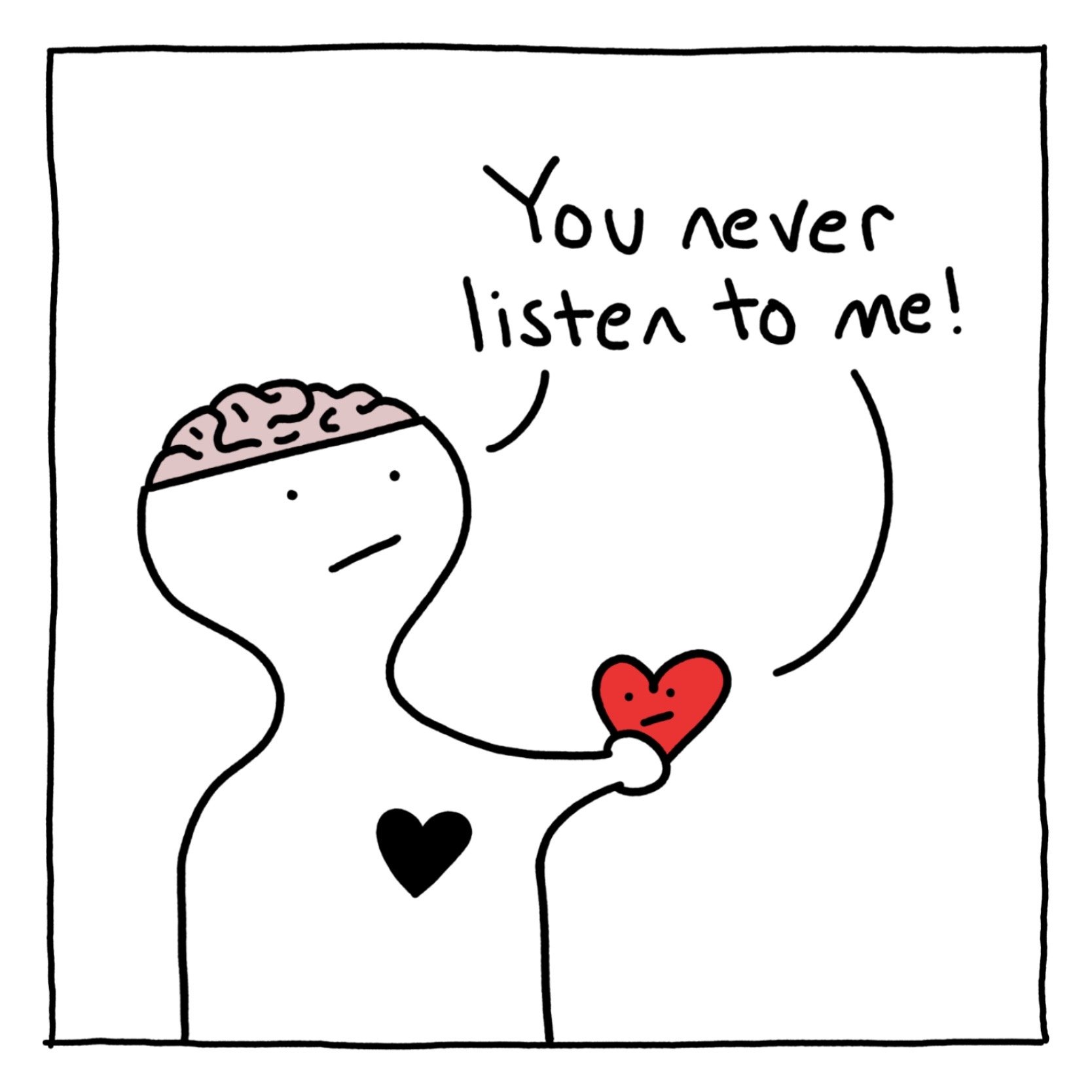
Ever notice how in most superhero movies, the main antagonist is simply an evil version of the hero?
I always thought this was lazy writing, but it speaks to the truth that the hardest battles we fight are with ourselves.
Of all the work I've put in to try and be the boss our employees deserve, nothing has had a bigger impact than reconnecting with who I am at my core.
Turns out I'm not a business owner who happens to be a human, I'm a human who happens to be a business owner.
The opportunity to live up to the promises we make.
This is every business owner's dream. We create and share in hopes of spreading our message so that people may be inspired, take action and share experiences with us.
When someone walks through the doors for the first time, there’s no more faking it. That picture you posted of that beautiful latte art that was more the exception than the rule, the podcast you record about your level of service and show, the hours you painstakingly spent writing copy about what you stand for, and the change you hope to make in the world—at that moment all those things are either seen as the truth or a lie.
You’ve either kept your promise or you’ve broken it.
We don’t always mean to break our promise and no one bats a thousand, but we need to ask ourselves a couple important questions:
Are we putting more effort into looking good than actually being good?
Are we telling the truth?
Sometimes the truth isn’t pretty. This doesn’t give us a pass to lie but it can give us the perspective we need to level up our reality.
I’m writing this from the lobby of a hotel that has broken its promise in more ways than one. I feel taken advantage of and it’s a way I hope any of our guests at Cat & Cloud never feel. The funny thing is, the experience isn’t terribly bad, it’s just miles away from the promise, and that dissonance is what’s creating the disappointment.
A brand is a promise. We can only break it so many times before our reputation precedes us and all those pretty pictures we post won’t matter anymore.
Being in the coffee industry, I love telling the story of the morning. People get up, shower, eat and head out to start their day with the beautiful tradition of morning coffee, so on any given day, the first person they interact with outside of their house is the person at the coffee shop.
That first interaction sets the tone for the day, and we're grateful to be in a position to set someone's day off in a positive way.
Your circumstances may be different but every one of us has the power to create experiences that can change someone’s world for the better. When we pass on positive energy, people carry around that energy with them long after the interaction is over and feel inspired to pay it forward to others.
It doesn't matter if you're the CEO of a huge organization or a dishwasher at McDonald's (proud alumni here), there’s no authority, permission, or money required—you already have everything you need inside you.
The trick is to see beyond the what and into the why. You might be making coffee, flipping burgers, or building spreadsheets, but at some point, everything you do connects in a way that transcends the product. How that connection lands is up to you.
Your work matters. Respect it.
Which feels more sustainable:
Trusting your team to move forward, however imperfectly, before they are ready.
The nonstop stress that comes with trying to do everything yourself.
Owning your losses gives your team freedom to own theirs. Trust goes up, the environment becomes safer, creativity is sparked, and people can put the fear of failure aside and focus on doing good work.
Attempting to hide your losses teaches your team that they should hide theirs. Trust goes down, the environment quickly becomes toxic, creativity is choked, and the fear of failure pushes people to become more concerned with looking good than actually being good.
If we’re going to play basketball, there are certain rules that come along with the game. Everyone agrees on those rules and as long as we respect them, we have tons of freedom to maneuver as individuals within those rules.
Without rules, we can’t appreciate the skill of the players. No matter how good of a ball handler someone might be, dribbling out of bounds to get to the basket is neither impressive nor effective.
Intentionally created workplace cultures have the same effect. Rather than boxing people in, a shared sense of purpose and a common language empowers employees to engage in critical thinking and be creative, not simply read task lists.
Almost paradoxically, channeling our creative energy within a framework leads to more interesting ideas than an unfocused creative free-for-all.
Some aspects of life are layered—we build on our past and add another brick to the wall.
Some aspects of life are transitional—as new doors open, others close behind us.
It’s often difficult for me to appreciate the good that’s happening around me in the moment. I’m poisoned by wanting more, by the desire to get to the next level.
For all the progress I’ve made, it’s not clear that I’m in a better place than I used to be. A different place, yes. But better? I’m not so sure.
Looking back on the experiences I’ve had on this journey it’s clear to me that each phase of our life is special and imperfect.
As much as each moment can be a springboard to our future, it's important to remember that we're actually living right now. Maybe you started a big project today, opened a new location for your business, or pushed through another day of pain.
It'll never be quite like this again and that's both scary and empowering. Try to enjoy it.
Our culture sees feedback in the workplace as synonymous with getting in trouble. This is probably because most people (myself included) have had less than stellar experiences with feedback.
My favorite experience was when the store director at a previous job asked me if I was too fucking stoned to stock our retail shelves in a timely manner. More of an outburst than feedback, this resulted in me immediately walking behind the counter to grab my coffee cup and backpack and head straight for the door. (I’m really good at walking out on jobs.)
Everybody left feeling worse that day. The store director didn't get what she wanted, and I had to go find a new job. Thankfully, there is a better way.
Building Bridges
Ongoing constructive feedback builds a bridge between the employee and the employer. When both parties know exactly what’s on the table and communication is constantly flowing, it’s easier to focus on your work. Work becomes more relaxing, even if you’re really cranking. Constant conversations build the relationship, and there's an ease in knowing exactly where you stand.
In addition to protecting your culture, consistent feedback acts as a pressure release valve. The tension never gets built up enough to spur a childish outburst that leaves you and your employee feeling worse than you felt before. Pro tip: berating people doesn't inspire anyone to do their best work.
So no, you’re not in trouble. This is an opportunity for two players on the same team to connect and get better. Take advantage of it.
Tomorrow Cat & Cloud turns five.
I feel compelled to send a laser beam of gratitude to my business partners. As I’m sure it is with me, their most positive attributes are also the most challenging to work with.
Jared moves forward with what feels like reckless optimism.
Charles supplies an endless bummer of reality checks.
I have uncompromisingly high standards to the point of being destructive.
Because we’re willing to accept each other's quirks along with the gifts, we’ve created a space in which we know that anything is possible, can turn dreams into reality, and do work we’re proud of.
Maybe it's not about accepting the quirks along with the gifts, maybe it's about recognizing that the quirks are the gifts.
I’m grateful for both of you. Cheers to five years!
End of content