

If you drink Specialty Coffee on a regular basis you’ve no doubt noticed the price increase of your daily indulgence. Inflation, cost of goods, the ebb and flow of the coffee market, and tip creep all have a part to play.
What used to be a $3.00 cappuccino with a $1.00 tip has morphed into a $5.00 cappuccino with 15%, 20%, and 25% tip options. (In California a popular Specialty Coffee chain has cappuccinos priced as follows: Santa Cruz: $4.50, San Francisco: $5.00, Los Angeles: $5.25. Prices will fluctuate depending on geography, and these prices were neither the cheapest nor the most expensive I found.) If we take the median of $5 plus 8% sales tax plus a 25% tip we’re landing around $6.75.
This is no joke for a daily habit. There’s also no shortage of basic breakfast options at any given cafe in the $12-$17 dollar range. Throw in a modifier or two (oat milk, add an extra egg, etc.) and you’ll face a tab close to $30 for your coffee plus a snack.
I added some items to a cart as an experiment. 6oz cappuccino ($5), add oat milk (.50), avocado toast ($13), add poached egg ($2), tax ($1.28), 20% tip ($4.10), total = $25.88.
A Note On Tipping
I have issues with tipping culture in general but setting that aside, if you have the gall to flip around a tip screen with a button that says 25% on it, you better be blowing my mind.
While I’m a business owner, I worked as a Barista for over ten years, and like them or not, I understand the role tips play in the lives of service workers. I also understand that you as a barista, didn’t choose the numbers that pop up as tip options, those are chosen by leadership. So perhaps the same note to business owners is prudent here. Business owners: If you have the gall to program a tip screen with a button that says 25% on it, you better be training your team to blow my mind.
A Screaming Deal
As annoying as price creep is, Specialty Coffee may still be underpriced considering the amount of effort and intentionality that goes into growing, harvesting, processing, sorting, shipping, roasting, and finally preparing it. Anyone who’s ever visited a coffee farm would be shocked at how much work goes into creating a product that’s so easy to take for granted.
What’s more, the best coffees in the world are a bargain. What would you expect to pay for a great bottle of wine, a top-tier cigar, or a rare whiskey? Coffee offers a flavor experience that’s more complex and nuanced than any of those at a fraction of the cost. But a great raw product isn’t enough.
While wine and whiskey come to us ready to drink, coffee, especially espresso, requires skillful preparation. I see many baristas going through the motions of making espresso but with little attention to detail and an absence of passion that’s hard to quantify—it’s almost an energy or aura that you can’t see but feel. (You know when you’re watching a true professional work.)
Again, my goal is not to take jabs at baristas. Employees are a reflection of leadership—they will put their energy into what leadership values, whether leadership states those values explicitly or not. But employees are also their own individuals, and despite being part of a less-than-stellar culture, we each have the opportunity to take ownership and hold ourselves to the highest standard possible. That’s a whole different article in and of itself. Back to the cafe!
Hospitality
The cafe is no longer the only place to get great espresso beverages. With the plethora of equipment and information available, the dedicated home enthusiast can make cappuccinos just as good, if not better than what they’d get at a cafe, and they can make it exactly how they like it, every time.
Amazing coffee is a must but by itself, it’s not enough. Our real opportunity is to create memorable experiences. Experiences that are so amazing that people can’t help but tell their friends. Experiences that fill people up with positive energy that they pass on to the people they interact with. These experiences are a gift and aren’t trivial. Our daily interactions at the coffee shop have more impact on our lives than the once-a-year vacation we take with our family—to undervalue them is a mistake. These experiences, good or bad, shape our lives.
Hospitality is a craft in and of itself. To treat people as guests, not customers, to see yourself more like an actor in a Broadway play than a register operator in a cafe. We have tremendous influence on the emotional state of our guests. I’m not talking about simply being nice. I’m talking about truly seeing people, meeting each individual where they’re at, and leaving people feeling fully taken care of. To be of service is a privilege, and if we carry that mindset into whatever we do, there’s no limit to the impact we can have or what the market will support.
Regardless of where we sit on the price spectrum, we should be aiming to take pride in our work and delight our guests, but when the sum total of the experience doesn’t match what we’re charging, we’re stealing. Great coffee being the bargain that it is, I’d happily pay $7 for a perfect cappuccino with the service experience to match. But $7 for an OK cappuccino with mediocre service—no thanks.
Leadership is more about building relationships than having authority.
Feedback from a trusted peer has more influence than an order from an untrusted boss.
The best breakdown I’ve seen of this philosophy is in John Maxwell's 5 Levels of Leadership. I’d recommend reading the book in its entirety but here’s the gist:
The 5 Levels of Leadership
1. Position - People follow because they have to.
2. Permission - People follow because they want to.
3. Production - People follow because of what you have done for the organization.
4. People Development - People follow because of what you have done for them personally.
5. Pinnacle - People follow because of who you are and what you represent.
Looking at these levels it’s easy to see how authority in the traditional sense only gets you so far, why the boss might not be the most influential person in the organization, and why being of service and having a strong sense of values is essential for anyone who hopes to have influence whether it be peer-to-peer, top-down, or bottom-up.
It’s easy to shy away from peer-to-peer feedback because we don’t want to feel out of line or like we’re “telling someone what to do”. But when done through the lens of service, feedback is an act of generosity that builds trust, while benefiting the individual and the organization.
You don’t have to be the boss to lead.
Asking the right questions is invaluable, but at some point, the professional needs to have answers.
Here’s a rule I use with my team: You can ask me anything you want, but to get my ideas, you first have to give me yours.
This encourages people to take the initiative to solve problems themselves, builds the muscle of sharing their ideas, and prevents them from using a never-ending barrage of questions as a place to hide.
It’s like the buy-in for a poker game. Bringing your ideas to the table means you have skin in the game.
Initially, your ideas might be off-center. This is to be expected and provides an opportunity for discussion and cultural alignment. Over time your ideas will become more on point, you will feel more empowered, and everyone from guest to owner will enjoy the benefits.
Once you understand enough, it’s time to take action. Your default mode can evolve from “Is this OK?” or “What do you think?” to “Here’s what I intend to do” and finally to “Here’s what I did.”
A Cool Boss
lets you slide
finishes your work for you
uses gossip as a means to connect
shirks responsibility
strives to be popular
A Good Boss
challenges you and holds you accountable to your highest level of work
never does anything for you that you could do yourself
holds the cultural line, even in the face of criticism or pressure
embraces responsibility
strives to be of service
Turns out a cool boss isn't that cool.
Much of the work you do when you’re young is less about expressing who you are, and more about discovering who you are.
Don’t worry about leaving your mark on a project.
Don’t approach your work from a place of selfishness or ego.
Don’t make it about you.
Focus on making a positive contribution to the team.
Do your best.
Work with intention.
Show up again and again in the service of others, and through these acts of service your gifts will begin to reveal themselves.
We all have gifts to share, but we can’t effectively share them unless we put in the time and effort to discover and develop them.
“I have a great idea that requires $20,000 in gear and two new full-time employees!” is less enticing than “I have a great idea that utilizes resources we already have!”
Start small.
Create a proof of concept.
Then scale (if you need to).
Most ideas aren’t killed by a lack of resources, they’re killed by a lack of commitment.
Gut Check 1: Commit before you start. If you’re not willing to bootstrap an idea, you might not be committed to it.
Gut Check 2: Think like a business owner. Don’t spend your organization’s money on anything you wouldn’t spend your own money on.
Professionals deliver. It’s what sets them apart from hobbyists. While hobbyists are in service only to themselves and can choose whether or not they finish a project, professionals are in service to others and must deliver.
Once you’ve chosen to be a professional, you have to decide what level of fit and finish you’re committing to honor.
It starts with a vision. Something to aim at. Since you will inevitably fall short of your perfect vision, you also need a standard. Something you can honor with your current level of skill.
Saying “I’ll only ship when it’s perfect” is a cop-out—a convenient excuse for never having to take anything to Z. Of course, saying “I’m completely comfortable shipping garbage” is also a cop-out.
What are the most important aspects of your work? What are the deal breakers? What do you absolutely need to get right the first time and what are you comfortable improving over time?
This is where professionals live: somewhere between perfect and good enough.
A Short Story
When I used to compete in barista competitions (yes, that's a real thing), one of my signature drinks required a garnish—an orange slice, inset into my serving tray, with an orange wedge sitting on top of it. I was obsessed with making everything perfect, and I spent over an hour cutting dozens of oranges backstage, trying to cut the perfectly shaped slice. Not only was it incredibly stressful, time-consuming, and wasteful—but by the time I had to go on stage, I still hadn't cut the perfect slice. When I looked back at the mountain of oranges I'd cut, the last slices weren't noticeably better than the first slices, and the first slices were definitely good enough.


Dialing in our financial projections for the year is probably the least favorite part of my job. I don’t do the heavy mathematical lifting, but looking forward and committing to a number that doesn’t exist yet can be anxiety-inducing.
When projections are conservative it feels calmer and easier to focus on what we want to do: How can we better serve and support our guests and partners?
When the projections are more grandiose, it’s easier to find ourselves chasing a fad or ignoring our mission and values to make a quick buck.
Of course, there is no such thing as a quick buck. If there were a button we could push to add another $250K to our bottom line, we would have pushed it already.
Year-Over-Year
There’s nothing special about the calendar rolling over. Your year-over-year is based on your day-after-day. Working steadily with intention, trading instant gratification for long-term stability.
But slow and steady comes at a cost. You might not make as much money as you want (especially in the short term) and you might not have all the fancy toys the big dogs in your industry have. You don’t need those things to create impact but there’s also nothing wrong with wanting them.
What are you looking for with your work? Are you ok without the fancy toys and the big salary? Are you comfortable bootstrapping? What does enough look like? Once you answer these questions you can pursue a path that fits your needs. If generating large amounts of income is at the top of your list that’s fine, but there are better ways to make money than owning or working for an independent business.
“We want to get rich, let's start a coffee company” wasn’t how Cat & Cloud came to be. Maximizing my income wasn’t the goal when I walked away from college to go make espresso for minimum wage. Different needs, different desires, different beliefs, different seasons of life, different choices—each with a cost.
What do you want? What are you willing to give up to get it? Choose your answers, choose your future.

In the vein of creative work:
I wrote a tiny book called Giving Up.
It’s about letting go of limiting beliefs and is a reminder that you have the ability to create something special.
It’s printed in Santa Cruz, California using Mohawk 100lb text paper (the good stuff). You can get it through Cat & Cloud here: catandcloud.com/givingup
I hope you enjoy it.
Reading through Brene Brown’s Dare To Lead, a modern classic on leadership, I kept coming back to a simple phrase in the first chapter. “Clear is kind.”
I’m somewhat of a reformed people-pleaser, and I can trace my people-pleasing tendencies back to my desire to fit in and have people like me (big surprise there). But when I step back and look at my life’s trajectory as objectively as I can, I find the times I've felt the most appreciated and valued weren’t when I mindlessly went along with the crowd or told people what I thought they wanted to hear, but rather when I was brave enough to be clear, open, and honest.
As a leader, it does no good to have unspoken expectations of your team. It’s unlikely people will hit a target they can't see.
My gut feeling is this is why so many bosses feel bad after they fire someone. Sure, there’s a certain amount of empathy for someone who’s lost their job, but there’s also a fair amount of guilt in knowing you didn’t give that person the best chance of success.
We shouldn’t do people’s work for them, but we are responsible for setting expectations and pointing them in the right direction.
Clear is kind.
It’s a mistake to think that your product and your promise are one and the same. That’s too narrow of a view.
I love our coffee, and I hope other people love our coffee, but I’m not under the illusion that people come to us for coffee. Within a stone's throw of our busiest cafe, there are four other options for specialty coffee. People can make coffee at home for a fraction of the price it costs them to come to Cat & Cloud.
Our guests don’t have a barrier between them and delicious coffee. That’s not the problem we’re solving.
As a business, having an amazing “product” isn’t exceptional, it’s simply a prerequisite for getting into the game. I’m using product in quotations because, at the end of the day, the real product is the experience we create. Amazing coffee is a necessary component of that experience, but it alone can’t carry the whole experience.
So if you think you’re in the coffee business, you might be right, but if that’s the only business you’re in, you might be in trouble.
Herman, one of our Team Leaders who happens to have culinary training, has been putting in time in the kitchen.
When Herman works in the kitchen, he wears a chef’s hat.
The first time I saw him wearing it, I knew exactly what he was doing. When I was a production barista, I always brought my own tools with me: tamper, towels, brushes, etc. Sure the shops had tools on hand, but I didn’t see myself as just a coffee shop employee, I was a Barista.
Putting on the hat or bringing in your own tools sends a signal.
A signal to yourself: I’m a professional, I’m proud of my work, and I’m here to get down.
A signal to your team: We’re doing something special here. (plus all the above)
A signal to your guests: We care. You’re going to be well taken care of. (plus all the above)
These signals can come to define your culture. “We’re the kind of coffee shop where all our baristas bring in their own tampers.” or “Most coffee shop kitchen staff don’t see themselves as chefs, but ours do.”
What signals are you sending?
It’s easy to get lost in one or the other. I go through phases where I’m addicted to dreaming—I create multiple worlds in my head or rant about how things could be better, all while lying in my bed or lazily complaining to my friends. On the flip side, I go through phases where I’m so lost in my work that I forget why I’m doing it. Work simply leads to more work and nothing meaningful changes.
We see specialized dreaming and doing roles in business. A CEO vs. a COO for example. But regardless of where we land on an org chart, we all have both dreaming and doing responsibilities for ourselves.
While we might feel more comfortable with one role over the other, my gut feeling is we all have a Dreamer and a Doer inside of us. Much like a business, we're at our best when we have a vision and a plan for moving toward that vision. We might have a community of friends or mentors, but the responsibility begins and ends with us.
Adopting a label of either a Dreamer or a Doer is a cop-out. Dreaming and doing are actions, not permanent states of being. We can choose to exercise both, or we can choose to make excuses for why our ideas never come to life or why we find ourselves stuck despite working so hard.
Often what keeps us stuck isn’t a lack of skills, information, or motivation, but surrendering to the limiting beliefs we have about ourselves.
Opportunity cost is easy to see in terms of material things. “I just bought a new car so I can’t afford to update my entire wardrobe.” But just like material things, beliefs and behaviors have opportunity costs.
What’s the opportunity cost of not believing in yourself?
What’s the opportunity cost of not taking responsibility?
What’s the opportunity cost of not developing and sharing your gifts?
These are the hard questions. This is the hard work.
Every day I wake up in the same room, sit in the same chair, and type on the same keyboard. I drive to the same building, order the same thing (espresso please), and connect with the same people.
Work moves at a glacial pace. In pursuit of the same vision day after day with projects that easily span quarters and sometimes years. To quote Austin Kleon in Keep Going: “Every day is groundhog day.”
When we’re in this perpetual loop, it’s easy to forget that what we’re doing matters or that our work has any impact at all. We falsely believe that because something feels boring or mundane to us, it must feel that way for everyone else.
Here’s a not-uncommon story: Someone discovers Cat & Cloud through our podcast, YouTube channel, or this blog, and decides to make us a part of their vacation to the West Coast—driving two hours out of their way from San Francisco or six hours from Los Angeles. This happens with surprising frequency.
The only reason for people to go so far out of their way is to have an experience. If they just need coffee, they can get that without driving for hours.
So what might feel like groundhog day for everyone behind the counter is something new and magical for someone else. When the road-trippers arrive, we have the opportunity to either make or break our promise. We can choose to live up to our mission of “Inspiring connection by creating memorable experiences” or not.
I’m sure you can see the problem here. Core regulars aside, we don’t know if someone drove across town or trekked 6 hours to get here.
So the obvious thing to do, the most impactful thing to do, the most fun thing to do is to imagine each and every guest has made a special journey to come see us. This also turns out to be true. Because even the people in our neighborhood have 5 other options for coffee a stone's throw away. Even the people who have been to Cat & Cloud hundreds of times still value the experience we create.
As stressful as owning a business can be at times, the adventure of driving to the same building, ordering the same thing, and connecting with the same people isn’t lost on me. I would miss it greatly if it were gone.
The story of your life is the story of what you do day in and day out. Just because you do something every day, doesn’t mean it isn’t completely magical.
Each season of life rolls out challenges for which we are unprepared but also capable of taking on.
It can be tempting to surrender to the overwhelm and drown in guilt or shame or the feeling of not being enough.
But the journey is long and there’s no need to beat ourselves up about where we are while we’re on the way to where we’re going to be.
Shopping for car parts online I added something to my cart, then, second-guessing myself, I used the contact form to ask a question about the part.
A week later I’ve gotten no response to my question but no less than three abandoned cart emails prompting me to finish my purchase.
So while I’ve had a handful of touchpoints with the vendor, none of them were useful for either of us.
I didn’t need a reminder that I left something in my cart, I needed my question answered. Service would have been the quickest path to a sale. I was ready to make a purchase, I just needed a tiny slice of attention.
But the system in place wasn't designed to connect, bring joy, or be of service, it was designed to capture.
It made me think about the allure of new and the devil on our shoulder, whispering in our ear: "Who cares about serving your current customers, how do you capture new ones?" (or personally "Who cares about your current friends, how can you get new ones?")
New is exciting, but the path to a worthwhile new is rarely ignoring the foundation we’ve built and starting from scratch each round.
When I only chase the dragon of new and exciting, I lose, and the people that have put their trust in me lose.
Conversely, the more I water the grass that’s right in front of me in both my business and personal life, the more I simultaneously deepen existing relationships and discover new opportunities.
The paradox of new: the most effective path to new is to put extreme intention and effort into what we already have.
As friends, artists, and business owners, we get to choose what we create—a veritable string of generic abandoned cart emails designed for nobody in particular, or experiences that bring joy and connection to people who truly appreciate and benefit from our work.
Paying attention to the people who are eager to engage with what we're creating is much more useful than trying to capture everyone's attention.
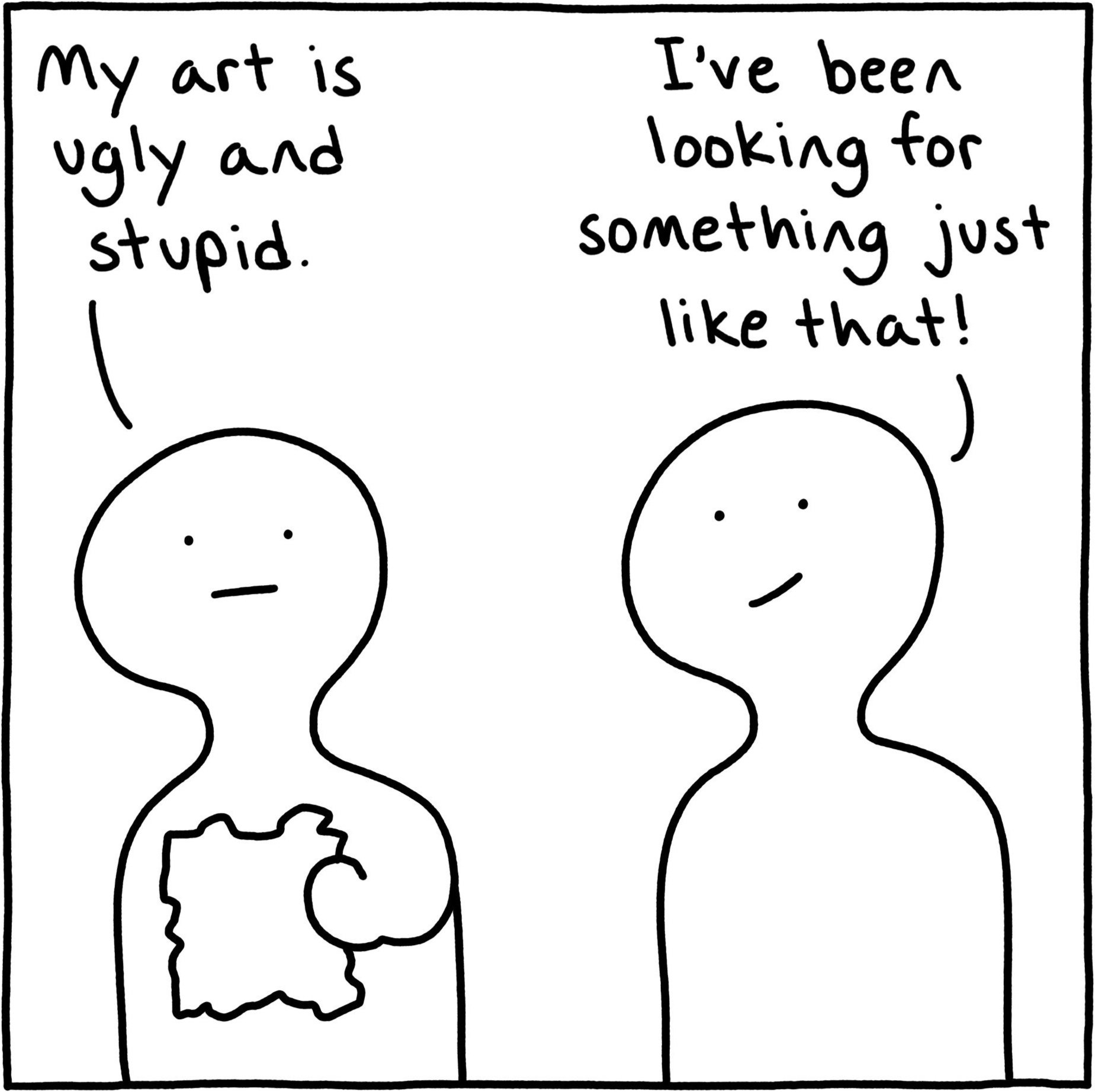
We have more than enough generic art. And by art, I don’t just mean pictures: generic service experiences, generic food, generic branding, and generic marketing campaigns telling generic stories.
I have a bad habit of trying to get so far away from generic that what I create is uncategorizable. While uncategorizable is fine for a hobby, it’s problematic for a business. How can people connect with what we do if they have no way to categorize it?
One of the things Seth Godin talks about that has shaped my perspective on how people can connect with our work is this idea of “genre, not generic.”
Genre as in rhyming with something people are familiar with, or knowing the established norms of an industry or culture. This reminds me of my love for focusing on the fundamentals. In the barista world, tamping level isn’t generic, it’s just what professionals do. Are you familiar with Track Changes in Word? If you’re an editor you are.
So the challenge is to create something that people can sink their teeth into without making it so generic that it simply blends in with everything else.
The formula might be something like this: Mastery of the Fundamentals + Your Quirkiness = Art I’d like to engage with. (A book I’d like to read, a film I’d like to watch, a coffee shop I’d like to visit, a picture I’d like to hang on my wall, etc.)
We’re waiting for you.
Whenever I take time off work, my vacation only starts once I shake the feeling that my absence will somehow create an alternate universe where things spiral in a direction I feel completely uncomfortable with, then when my vacation is over I’ll come back to a workplace that only vaguely resembles the one I left.
But every time I return from a break, things are always more similar than they are different. This isn’t because it’s impossible for change to happen without me, but rather that creating change is difficult. Change is lumbering—even with huge changes in policies and procedures, change in behavior is slow to catch up.
So if you're taking time off work, give yourself permission to fully disconnect. The universe you return to won't be much different than the one you left.
Right now, at this moment, the job you have is the best one you can get.
If you think the job you have isn’t the best one you can get, by all means, go get that other job!
But if this is where you’re going to be, for now, choosing to take it as seriously as you would your dream job is a great investment in your future.
When you fully engage with your work, magical things happen. You put yourself in a position to brighten the days of your teammates and guests, increase your chances of getting promoted, and are more likely to get noticed by that guest who happens to work in the field you’d like to be in.
You also become the kind of person who does quality work—a person that other people can count on. And that says more about your character than the job you have or the title on your business card.
Right now, at this moment, this is the best job you can get. You should be proud to have it.
End of content