

Barista Education Gone Wrong
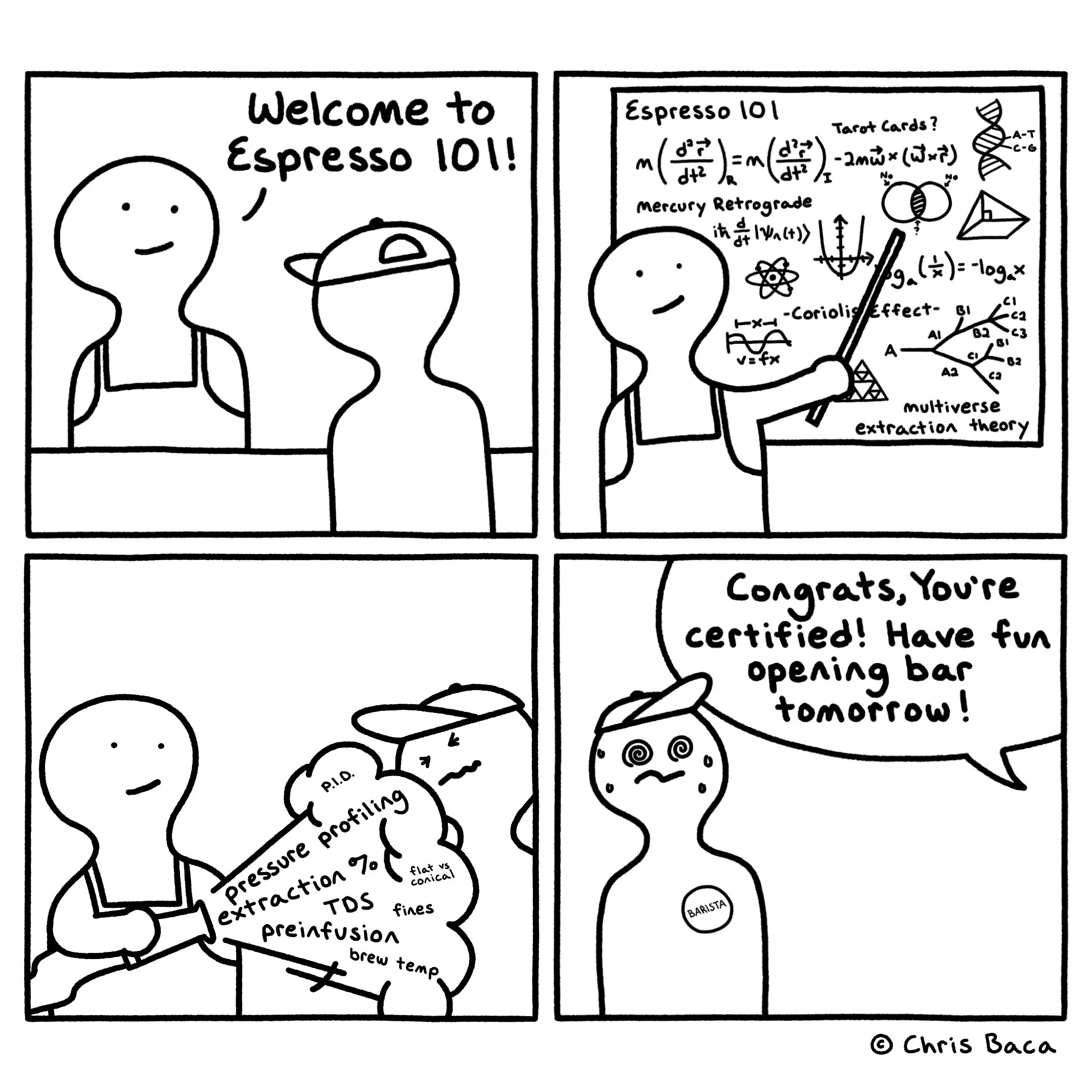
Me: “You should’ve fired me.”
Eileen: “Why? We were all just figuring it out.”
To my terror, another coffee professional mentioned that my old boss Eileen had given her the encyclopedia-thick training manual that two other coworkers and I developed sometime circa 2008.
“You mentioned there were 86 factors in making good espresso,” she said.
I was mortified.
“I’m so sorry you had to see that,” I responded.
I remember working on that manual. It was great fun. Pouring every ounce of knowledge you have into a complete resource that would turn anyone willing to burn 300 hours of their life reading it into a stellar Barista.
But we had it wrong. Not that there’s anything wrong with long-form distillation of knowledge, or that to progress past a certain point in your career it becomes important to understand the Whys behind the Whats. But wrong in thinking that a new Barista needed to know everything we did in order to do a good job. Breaking down the handful of things that, if done consistently well, would get people 85% of the way there would have been more immediately useful.
I’m not taking the easy way out here—despite espresso fundamentals being so simple it’s laughable, it’s completely normal to get mediocre espresso and cappuccinos from coffee companies with stellar reputations. And quality certainly suffers from the pressure of the rush, where fundamentals break down minute after minute in the quest for expediency. Great espresso is simple, not easy.
Ego (Albeit Well-Intentioned)
Most of my motivation to construct this behemoth of a manual was pure—I was at the apex of my love affair with coffee and wanted to share what I’d learned to help other people. But part of it was certainly ego-driven.
I walked away from college to pursue a career as a Barista. It wasn’t considered a “serious” profession, and although we got a reasonable amount of respect from other hospitality industry professionals, we were mostly seen as punk kids with no path or direction. I wanted to prove everyone wrong by saying, “You’re wrong about us. We take this seriously. This is as complex and intricate as wine or fine dining, and here’s the proof.”
We were writing for the career Barista, when I’m not sure such a thing ever existed—or if it did (perhaps I was one of them), they were so rare it was almost a moot point.
Most people engage with the Barista position as a stepping stone to something else—for most people it’s more of a job than a career, and that’s OK. Just because a position is temporary doesn’t mean we can’t take pride in it and take it seriously, but setting up a casual user for success requires a different approach than training a champion.
Ubiquity Creates Tension
At some point, instead of being one or two high-end specialty coffee shops in a hundred-mile radius, there were dozens, and they needed a workforce. Slots that were once reserved for people who bled espresso were opened up to dabblers. This unintentionally created tension between serious “career” baristas and more casual users.
In an effort to protect the standard of what they love, many well-meaning educators responded by inadvertently beating the newcomers into submission by making espresso seem overly complicated. We accidentally created a wave of Baristas who felt afraid of making espresso.
Confidence, Fun, and Love
Instead of making espresso as complicated as possible, we can set Baristas up for success by making them feel as confident as possible. As people progress through their journey, we can layer on knowledge in the right doses at the right times, challenging them, but not destroying them.
This means setting your ego aside. Resisting the urge to constantly flex all your intellectual muscle. Teaching isn't about the teacher—it’s about the student.
Empowerment, confidence, and fun pave the path to falling in love with your job. Once love kicks in, we won’t have to do much training at all—people will figure out everything they need to know for themselves.