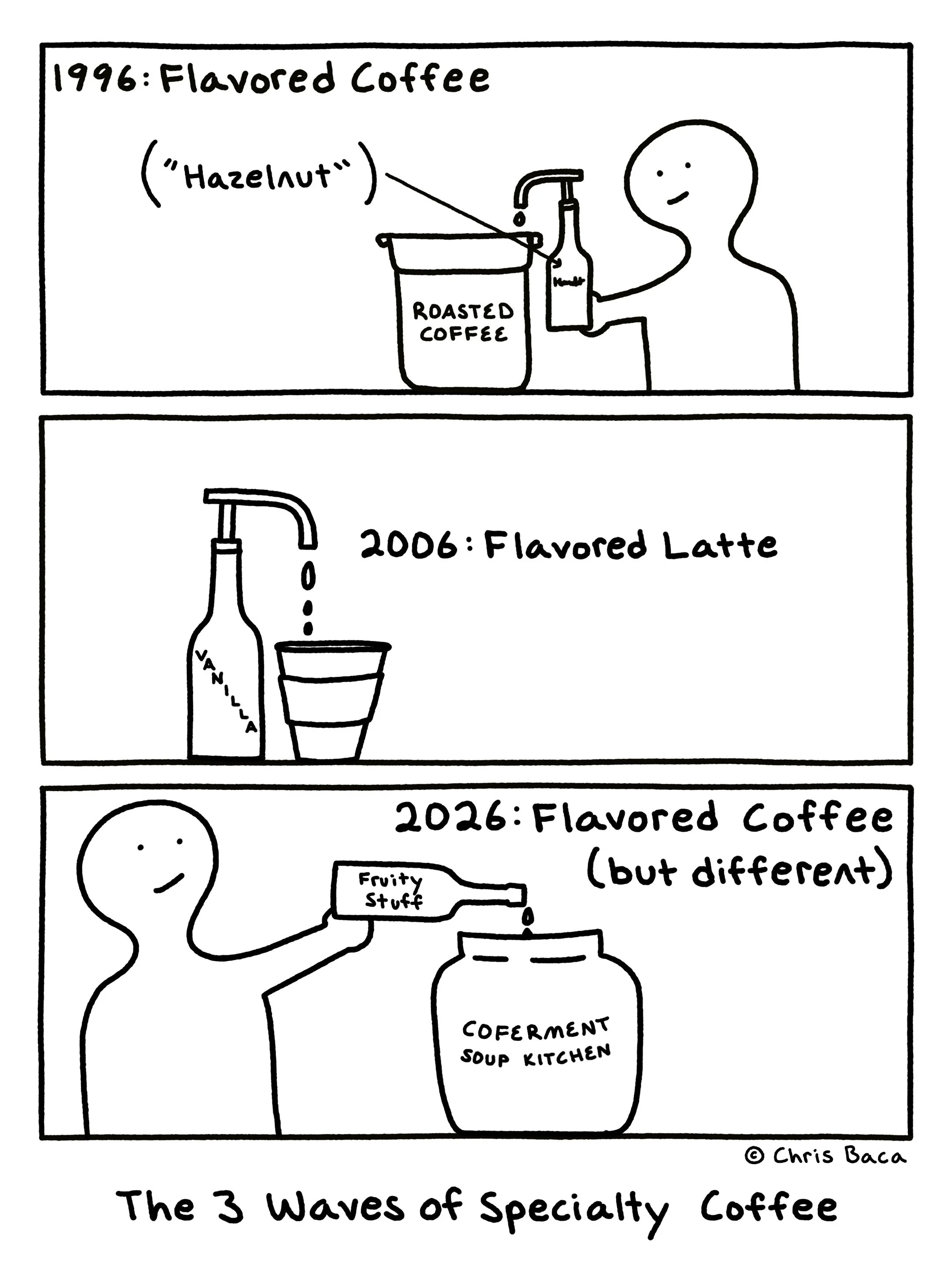

Co-Fermented Coffee: How Can You Tell the Difference Between A Fad And The Future?
Last Week I attended the San Francisco Coffee Festival—a smorgasbord of coffee roasting and retail companies running booths stuffed inside the Fort Mason Festival Pavilion.
The majority of roasters seemed to be participating in the “who can offer the wildest coffee processing and co-fermenting” olympics. While I don’t enjoy most of these coffees, I understand their appeal and the desire for the market to be in continuous evolution. For better or worse, today’s culture does not want to be yesterday's culture.
These non-traditionally processed coffees are having a moment in the Specialty Coffee Industry. They’re popular, but polarizing. Will the trend pass, or will it stick?
Timeless, or Stuck In Time
The first shop I ever worked at in the early 2000’s had been in business since the late 80s. We pulled espresso to order, but using dark, oily coffee. We steamed milk ourselves but piled on heaps of dry foam. I enjoyed the coffee at the time, but it certainly wouldn’t stand up in the modern specialty scene.
When I discovered there was a coffee revolution happening, I began to bring in coffees from early third-wave roasters to play with. The family who owned the shop also owned the roasting company that supplied it, and they were kind enough to let me come in after hours to experiment with new coffees and burn through gallons of milk practicing my latte art (which took a while to learn in a pre-YouTube, pre-social media world). Despite supporting my curiosity, the owners of the shop thought all this new stuff was simply a fad. We never assimilated into the third-wave movement.
Years later, I was surprised to bump into the tech from that same company at the SCA show while I was competing in the U.S. Barista Championship.
Me: “You come to these?!”
Tech: “Oh yeah, we’ve been coming forever!”
At that moment I realized that they had likely seen Barista competitions before I ever did, and were fully aware of the espresso revolution yet chose not to participate. The roasting company still exists. Their website looks like it was built in 1994. They have all the same blends they had when I worked there. I’m not disparaging them—I had a great experience working there, but you can see where I’m going.
Becoming The Next Dinosaurs
The knife cuts both ways. Trends provide a smokescreen where quality takes a back seat to what’s hot in the streets, but at the same time, trends are often spurred by experimentation, which drives progress.
If you weren’t pouring latte art during the espresso revolution of the late 90s and early 2000s, you were being left behind. Is the same true of allocating a certain amount of menu slots to experimental processing methods now?
I’ve chatted with a few owners of well-respected modern Specialty Coffee roasting companies, most of them unenthusiastic about the popularity of these new crazy coffees. When I hit them with the big question: “How can you tell you’re not slowly becoming the next dinosaurs—rooted so firmly in antiquated beliefs that the industry will slowly pass you by?” Most don’t have a good answer.
Questions Worth Pondering
How can you tell the difference between a fad and the future?
How can we tell if our point of view is timeless or we’re simply stuck in time?
Are we hanging onto a point of view that ensures we’ll be yesterday's news, or are we losing our unique point of view by chasing every new trend as it comes our way?
What’s the balance between dancing with trends and carving out our own path?
What industry are we really in?
Who are we trying to serve?
Does the monolithic Specialty Coffee industry even exist?
Be 25 (The Solution For Almost Everything)
When I was a 25 year old coffee professional, I was driven by curiosity. I had strong opinions, but I wasn’t emotionally attached to them. I wanted to be accepted by my industry peers, but not by being so cookie-cutter that I completely disappeared into the pack. I had awareness of what was going on in the industry and gave myself the freedom to experiment with, and accept or reject any given trend based on those experiments. I didn’t give a sh*t about a balance sheet—I only cared about my craft. Most of all, I trusted my gut. I can’t be 25 again, but I can put my 25-year-old hat on and act as if.